
Where to Play and How to Win are the two middle boxes of the Strategy Choice Cascade, and they work as a pair. A market is only worth entering when you have a way to win in it, and a way to win is worth having when you have somewhere to use it.
Roger Martin calls settling one before the other the single biggest practical mistake he sees in the application of Playing to Win. It happens because the cascade diagram flows left to right, so teams answer the boxes in that order and lock and load on each one before moving on. Note the arrows pointing back up the cascade!
This page shows what a matched pair looks like, using Apple and Riverford, and what it costs to buy into a market you have no way of winning.
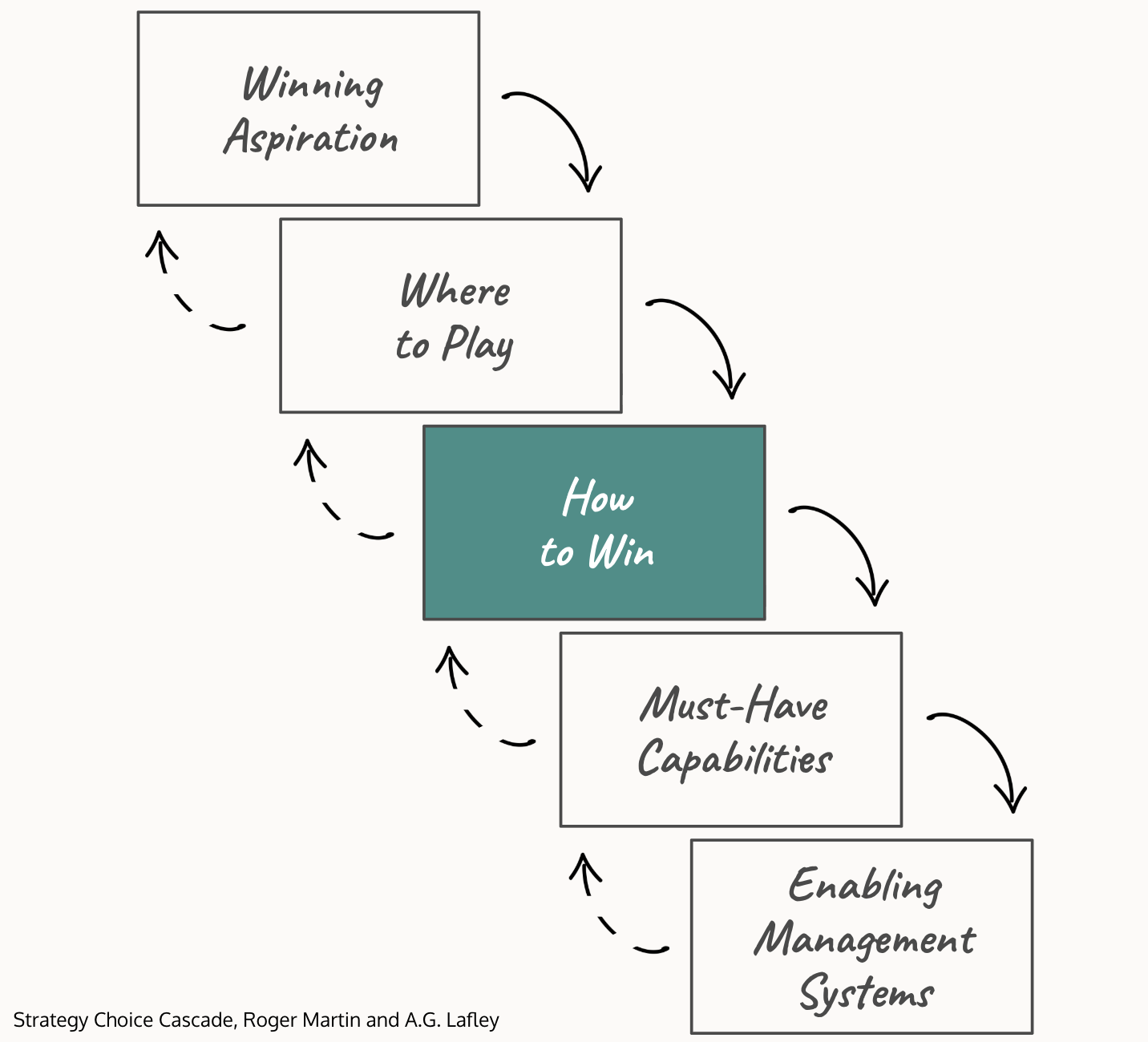
It's important to ask of any market whether you have a way to win in it. Martin's answer when you cannot name one is that the market is a bad choice, however attractive it looks from the outside.
The attractive features are the trap. China is big and growing. Rich customers have the most to spend. Upstream is where the bigger budgets lie. Specialty products carry the higher margins.
But every competitor can read those same facts, so they all move to the same place and the attractiveness that drew them there disappears.
The solution is to work the two boxes together. When a way to win comes to mind, ask which market it would suit perfectly. When a market comes to mind, ask what would let you win there.
"The determining question is whether you have a great HTW for that WTP. If you don't, it is a stupid WTP."
- Roger Martin
Martin keeps the two in separate boxes for a reason. Splitting the thinking into tractable parts is what makes a strategy possible to work through, but the parts get sense checked against one another by toggling your thinking back and forth.

When Steve Jobs first launched the Macintosh, he told the audience Apple would not attempt to sell it to big corporate customers, by far the biggest segment of the market. Instead, Apple would focus on creativity-intensive organisations: film studios, design companies, publishers and the education sector. A much narrower market, matched exactly to a way of winning built on graphics and the user interface.

Riverford sells organic veg boxes direct to British households on fixed weekly rounds. The founder, Guy Singh-Watson, made the choice to move away from supermarket supply entirely by 2002, after a buyer told him that when they whistled, he should jump. The company also ruled out air freight, which rules out most of what a supermarket stocks in February.
Both choices narrow the where to play, and the narrowness reflects the way Riverford wins. Because customers subscribe, the company knows every drop-off before the van loads, so it can plan rounds dense enough to make home delivery of cheap perishables pay. A retailer selling the same boxes to whoever happened to order this week would be driving between scattered addresses.
"Ever since telling a Sainsbury’s buyer where they could stick their measly 6p per lettuce, we have focused on selling directly to customers via our veg box scheme."
- Guy Singh-Watson
Riverford chooses to only sell what its own farms actually produce. It grows much of it in Devon and in the Vendée, where the company's French farm exists to cover the hungry gap of April and May without flying anything in.

Take your three most attractive markets and write each one at the top of its own sheet.
Underneath, write the sentence that says how you would win there. Name what you would do better than anyone else, and say why a competitor could not easily copy it.
Any sheet that stays empty comes off the wall. Martin's advice is to scrap those markets rather than carry them into the plan.
For the ones that survive, ask both questions. Would our way of winning get stronger if we took on more of this market? Would it get stronger if we took on less?
The pairs start here. The executive team writes a small set of possibilities before it chooses between them.
This is the test that follows. Turn a possibility into conditions, find the one that matters most, and go and check it.
See where Greggs, Tesco, Marks and Spencer and five others chose to play, and how each of them planned to win there.
I facilitate Playing to Win processes for executive boards and leadership teams. I bring the method, the questions and the pace. Your team makes the choices and owns them afterwards.