
Most strategy debates ask the wrong question. "Is this a good idea?" invites opinion, and the loudest opinion usually wins. A better question is "What would have to be true for this to be a good idea?" as it invites a list of conditions, and conditions can be tested.
The question comes from Roger Martin and A.G. Lafley's Playing to Win method. It is the step that turns a room of advocates into a room of investigators.
This page explains how the question works, how I run it with executive teams, and how to use it on your own strategy.
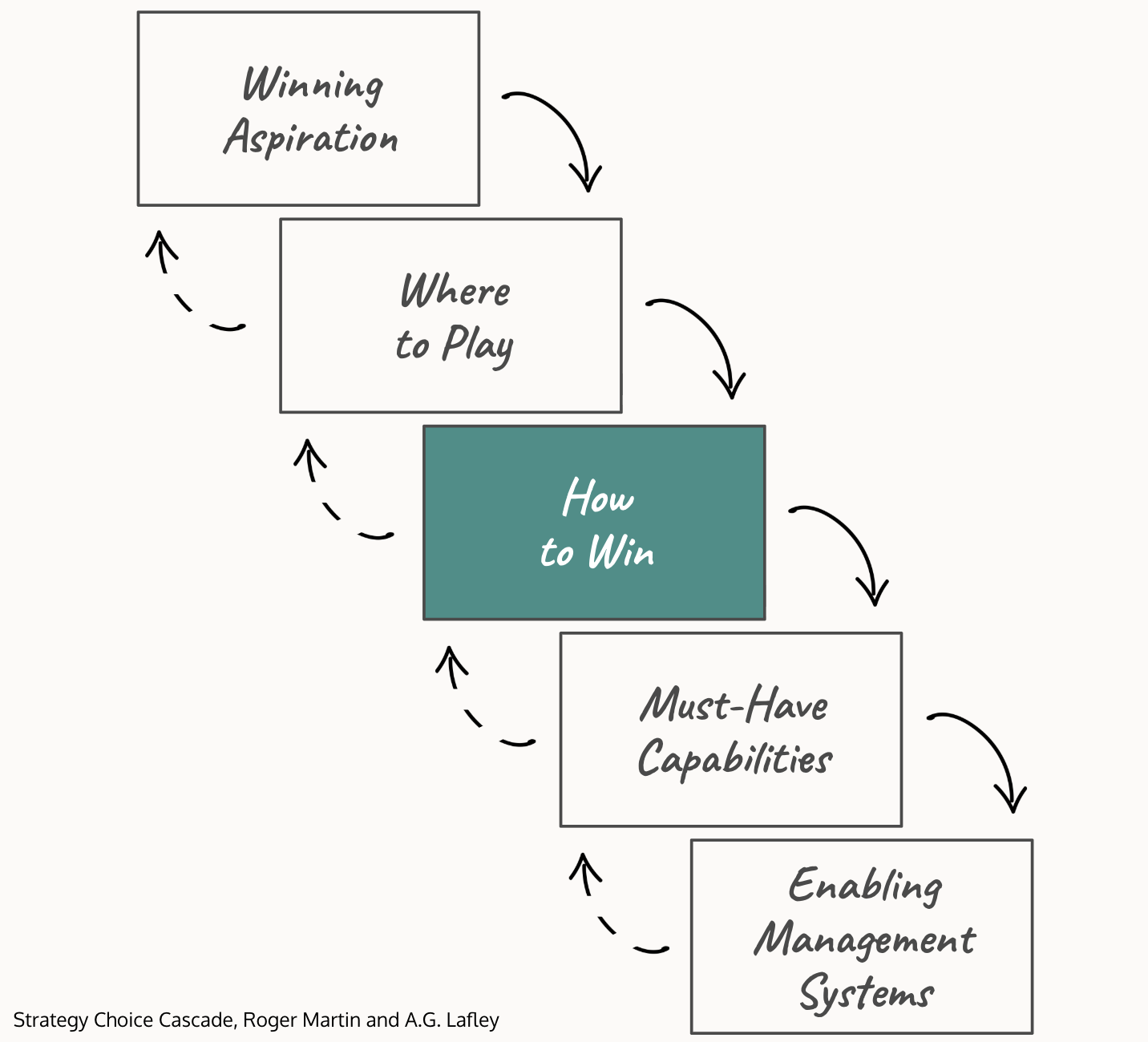
Take one strategic possibility. Ask the team to finish this sentence as many times as they can:
for this to work, it would have to be true that...
The answers usually fall into a few groups:
what customers would have to value
how the industry or channel would have to behave
what competitors would have to do or fail to do
what the company would have to be capable of
what it would have to cost
Now the list is on the wall, ask a second question of each condition: how confident are we that it holds today? Most conditions turn out to be safe. One or two are the whole bet. Those are the barrier conditions, and they are the only ones worth testing.
Then design the cheapest test that would settle each barrier condition, run it, and choose. The team has spent its analysis budget on the two things that matter, and the person who doubted the option has designed the test that could kill it.

Give the most doubtful person in the room the job of naming the conditions for the option they like least, or have least confidence in.
They will find the real weakness faster than anyone, and they now have a stake in testing it fairly.
The method is set out by Lafley, Martin, Rivkin and Siggelkow in Bringing Science to the Art of Strategy (Harvard Business Review, 2012).
I use it whenever an executive team has split between two options.
A useful way to frame this exercise is with its scientific grounding. As Martin says, developing a winning strategy involves the creation and testing of novel cause-and-effect hypotheses and the identification of what must be different about the world for those hypotheses to work. I find this builds confidence with the group that ideas will be tested fairly and thoroughly.
The simple word "true" does a lot of heavy lifting here too. By asking what would have to be true, you're implying that other things are false, and nobody wants to go along with those.
You're also explicitly inviting the person most sceptical about a particular idea to set the test, for them to say, "For me to be confident in this possibility, this is what would have to be true."
For example, they might say, "I'd have to know that enough customers would be willing to buy this widget at a price that would make it profitable for us." This is a much more constructive statement than "that will never work."
Working with the sceptic, the group can then design a test to answer the question, and it's key that the sceptic is involved in specifying this test. For the example above, it might involve surveying an agreed amount of customers, or setting up an A/B test on the website with the proposed price.
Once you have a list of what would have to be true conditions, see if you can rank them according to which you or the sceptics view as least viable.
You can then prioritise those that you really need to spend time and effort testing thoroughly. Pick the ones that you believe are least likely to hold true first, because if these fail, then there's no point in you testing the other conditions.
If you can't agree on priority order of the conditions, treat them as equal.
The step before the test: how a board writes a small set of real options, with the status quo among them.
Draft your own cascade in seven questions, then write the conditions it depends on and email yourself the result.
Olay to Lego, each with the barrier condition that had to hold and what happened once it did.
I facilitate Playing to Win processes for executive boards and leadership teams. I bring the method, the questions and the pace. Your team makes the choices and owns them afterwards.