
My recommended approach to strategy development is built around Roger Martin and A.G. Lafley's Playing to Win framework. The core idea is that strategy is a set of integrated choices.
As well as helping an organisation define its strategy, this approach also aligns the organisation on how to resource and execute it, by cascading down and across departments and teams.
The end result is a coherent, interlocking strategy where everyone can see how their role and function contribute to the bigger picture.
A.G. Lafley was chief executive of Procter and Gamble (P&G). Roger Martin was his strategy adviser, and later Dean of the Rotman School of Management in Toronto. They developed the approach at P&G in the 2000s and set it out in their 2013 book.
- A.G. Lafley
- Roger L. Martin
Let's pick apart a few of the key elements of Playing to Win.
The act of defining strategy is to choose what you will and will not do. Playing to Win helps leaders identify key choices to be made, barriers to making those choices, and tests to enable decision making.
The Strategy Choice Cascade asks leaders to answer five questions, and each one asks for a choice to be made.
The choices should reinforce one another, for example where you compete shapes how you succeed there, which shapes the capabilities you build.
Playing to Win's Strategy Choice Cascade is a system rather than a linear sequence, so for best results the five elements should integrate with each other.
As Martin says: "When a company sets out to participate, rather than win, it will inevitably fail to make the tough choices and significant investments that would make winning even a remote possibility."
Winning means naming the customers you intend to serve better than anyone else, and accepting that you will serve others less well.
- Roger L. Martin
These five linked questions form the backbone of Playing to Win.
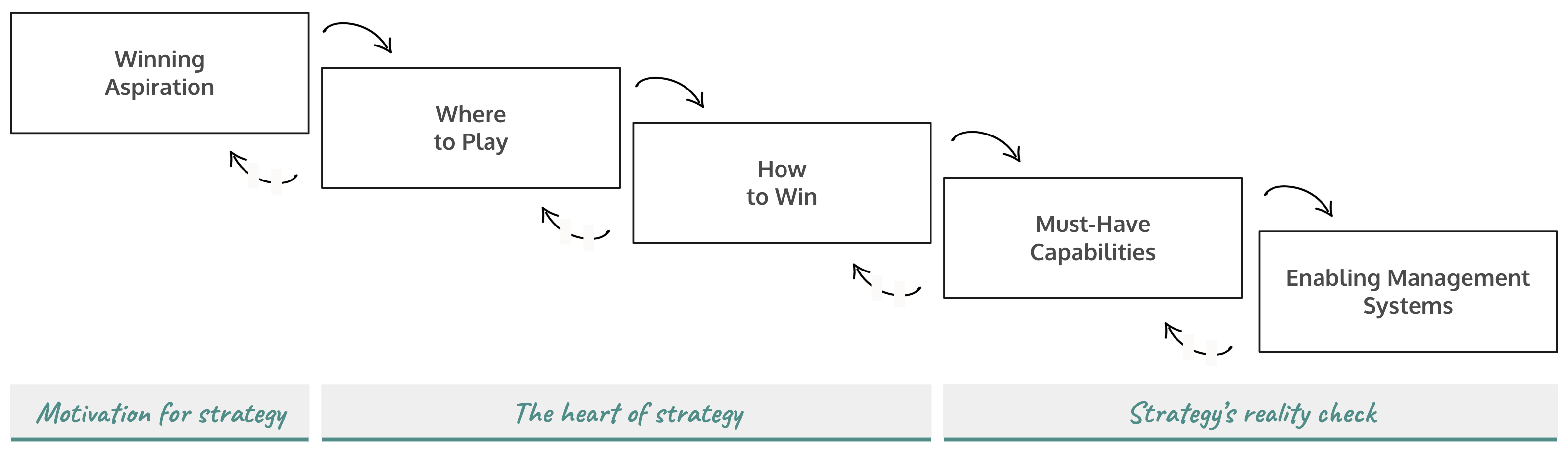
The first box should define what winning looks like for your organisation, framed around customers, and not just a financial target. What are you trying to accomplish?
The specific playing field: including geography, product type or category, consumer segment, channel, and stage of the value system. It should equally define where you will not play. A good answer here provides a genuinely choiceful playing field that enables your How to Win, not simply the most attractive market for everyone.
The key box: this is where you define how you will create and capture value in your chosen field so that customers choose you.
The small set of capabilities that, working together, make your How to Win real.
The systems, structures, measures and processes that build, maintain and reinforce the must-have capabilities.
fgjftyjgj
Ask everyone to write the two answers on a card, privately, one sentence each. Collect them and read them aloud without names.
Teams who believe they are aligned often find several different strategies in the pile. It is a fast way to locate the real work, and it starts the session on evidence the team produced itself.
These two questions only work when answered together. A playing field on its own describes an ambition to be present somewhere. A way of winning on its own floats free of any particular customer.
Held together they make a claim you can test: these customers, for this reason, better than these competitors.
The pairing is also what makes a strategy usable below the board. A manager who knows both can decide most things without asking, because they can see which options fit.
Ask everyone to write the two answers on a card, privately, one sentence each. Collect them and read them aloud without names.
Teams who believe they are aligned often find several different strategies in the pile. It is a fast way to locate the real work, and it starts the session on evidence the team produced itself.
These two questions only work when answered together. A playing field on its own describes an ambition to be present somewhere. A way of winning on its own floats free of any particular customer.
Held together they make a claim you can test: these customers, for this reason, better than these competitors.
The pairing is also what makes a strategy usable below the board. A manager who knows both can decide most things without asking, because they can see which options fit.
Ask everyone to write the two answers on a card, privately, one sentence each. Collect them and read them aloud without names.
Teams who believe they are aligned often find several different strategies in the pile. It is a fast way to locate the real work, and it starts the session on evidence the team produced itself.
Write down the opposite of your statement. If the opposite is something no sensible organisation would say, the original was a statement of intent.
Run this across a draft strategy and it usually gets a good deal shorter. What remains is the part that will guide a decision.
When a team splits between two options, the argument runs on conviction and has nowhere to go, because both sides are arguing about a future neither can see.
Rather than asking which option is right, ask what would have to be true for each option to be a great choice.
Write the conditions that would make option B a brilliant choice.
Write the conditions that would make option A a brilliant choice.
Nobody is defending a position, so people think properly. The team ends up with two lists of conditions, agrees which it doubts most, works out what evidence would settle them, and goes and gets it. The argument has become a piece of research with an answer at the end.
Write the conditions down verbatim, in the team's own words. When evidence comes back weeks later, a team that can see the exact condition it named will accept the answer.
The question "What Would Have to Be True?" sits inside a longer sequence Roger Martin developed for working a strategic choice from start to finish, the Strategic Choice Structuring Process (SCSP).
The SCSP turns the Cascade from a framework into a working method.
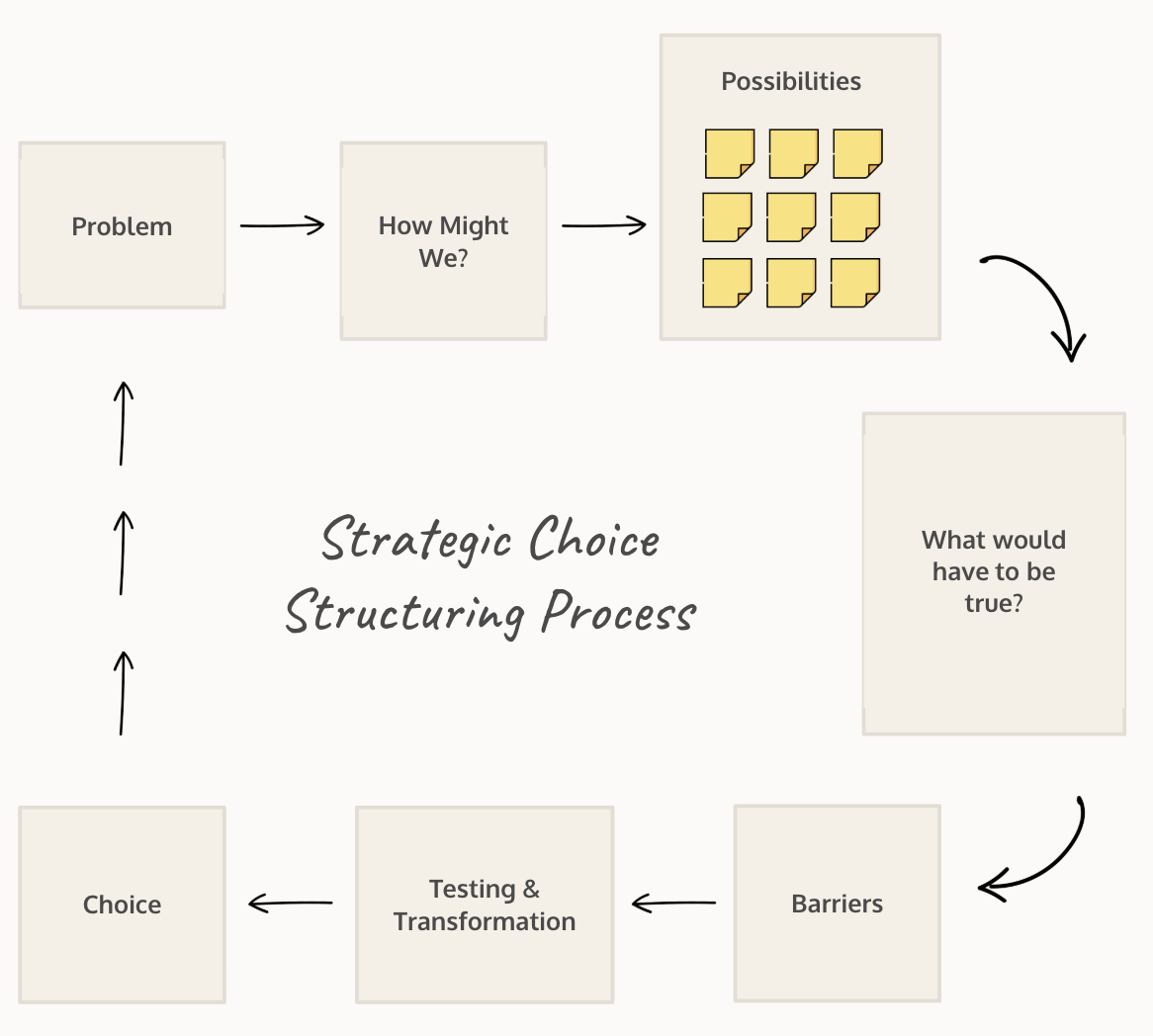
A choice invites a decision. Crystallising issues by clearly framing choices for resolving them makes them immediately real and meaningful. The task here is to create mutually exclusive options that stand in opposition to one another.
Martin calls these "happy stories," and we're looking for a wide range of diverse possibilities, each one written as a single sentence: a move we could make, and the prize that follows. There are only two rules. The gap we're trying to close has to disappear inside the story, and the choices needed to make it real have to be listable. It doesn't have to be true yet. Creating a commitment to openness and establishing psychological safety within the group is key at this stage.
What would have to be true for each one to be a great choice? This is reverse engineering the logic of each possibility. This removes the option of judging possibilities based on opinion.
Now the group can express which of the conditions set in the previous step are the least likely to hold true. This is where to encourage sceptical group members to raise concerns and identify which conditions really need to be tested.
Once we've identified key barriers, we move on to identifying compelling and valid tests. Again, this is where the sceptic can be useful, in setting a test that would satisfy their standard.
Here, the group can test the conditions they feel are the least likely to hold up first. They then move through other conditions in order of confidence level.
Having completed the above steps, the step of choosing becomes simple, and the group can move forward confidently.
One of Martin’s favourite anecdotes involves the Chevrolet Malibu and the Toyota Camry, two mid-sized sedans that were once locked in fierce competition for dominance in the US market.
The Malibu team had their eyes glued to the wrong target. They weren’t asking, “Are we building the best car?” (i.e. winning) but instead, “How can we double our sales numbers?”
They wanted to increase the previous year’s Malibu sales of 60,000 to a new target of 120,000. The Malibu’s main competitor, the Toyota Camry, sold 560,000 per year.
Martin asked the Malibu team: “How does the new Malibu actually stack up against the Camry?” to which they answered: “We don’t know.”
The Malibu team, obsessed with achieving a revenue target, lost sight of what really mattered: whether their product could compete with the Camry on quality and customer experience. They weren’t thinking about the larger competitive landscape. They were focused on improving on the last Malibu rather than making the big strategic choices needed to actually win against the Camry.
Martin went on to work with the Malibu team to benchmark against the Camry, and make the necessary improvements so it could compete. As a result, the Malibu went on to reach sales levels four times its initial target.
This is one of the most common ways a strategy conversation goes wrong. The growth target arrives first, the plan is built to deliver it, and nobody asks the question underneath: why would a customer choose us over the thing they are buying today?

How do we double our sales?

This question is usually only answerable by working harder at what you already do. It compares you with yourself.

How does our car compare with the one people actually choose to buy?

This question is best answered by looking outward, and it usually changes what you build.
Other models can be useful when a team is stuck at a particular question.
It's not necessary to use all these models in every piece of strategy development. Deciding to use them should be based on the particular challenge faced and the existing insights available.
I facilitate Playing to Win processes for executive boards and leadership teams. I bring the method, the questions and the pace. Your team makes the choices and owns them afterwards.
Lafley and Martin are clear that every line of business and every function should have its own where to play and how to win, aligned to the one above it. Strategy belongs to teams facing inward as much as the ones facing customers.
Which businesses we are in, and how the whole is worth more than the parts.
Which customers this business serves, and why they choose us over the alternatives.
Who this function serves inside the business, and what it does better than an outside supplier could.
A function that answers those two questions stops being a service desk and starts making choices. An HR team that has decided where it plays can say what it will stop doing, which is the same discipline the board applied above it.
The nesting also gives you a test. If a business unit's answers could sit under any group strategy, the group strategy is probably not making a choice.
Size matters less than you would think. A ten-person business and a listed group answer the same five questions, and the smaller team often answers them faster.
Playing to Win answers the first question in the method I use with leadership teams, which I call On The Same Page. Strategy sets the direction. Four more layers decide whether that direction survives contact with the organisation.
Where will you compete, and how will you win? This is the layer Playing to Win answers.
What standards do you actually set? Choices hold when leaders behave the same way outside the room.
How does the org chart become an organisation? Strategy travels through the handovers between teams.
What happens when nobody is watching? What gets rewarded decides which choices stick.
What does the outside see? The evidence of whether the choices reached the customer.
The five work as a system. Strength in one raises the others, and problems travel between them. A strategy that keeps getting revisited is often a leadership problem, and a culture problem often turns out to be a teamwork problem.
Which is why a completed Cascade is the start of the work. Most organisations get their strategy broadly right and lose it in the gap between intent and behaviour.
The method is public and the books explain it well. What varies is what happens when a leadership team sits down to use it.
The team works on an A1 canvas with the five blocks laid out, using sticky notes, credited to Roger Martin on the sheet. Everything stays visible and anyone can move it, which keeps the session collective rather than a series of presentations.
I speak to each person who will be in the room before the first session. Sessions that start from what the team actually thinks move much faster than sessions that start from what people say in front of each other.
When the board names the conditions it doubts, each gets a board member's name against it. The test comes back to the person who asked for it, and the finding gets accepted instead of relitigated.
For a group-level review, a cross-functional working group builds and tests the possibilities while the board frames the questions and makes the choices. The value sits in the passes between them, and each pass needs designing.
The output is a completed Cascade in the language the team used, alongside the possibilities they set aside and the evidence behind the choice. A strategy people can quote is one they can apply.
The source. Sets out the Cascade and works through it with examples from Procter and Gamble. Start here.
Martin's collected thinking on strategy, competition and management. Useful once the Cascade is familiar and you want the reasoning underneath it.
On holding two opposing ideas at once and building a better answer from both. It explains why What Would Have to Be True works as well as it does.
Martin publishes regularly and has made a set of practitioner materials freely available. Worth following if you plan to run the method yourself.