
Before a leadership team can choose where to play, it needs a shared picture of what is moving around it. The Strategy Radar is my tool for building that picture.
It helps teams appreciate the forces biting today, forces taking shape several years out, and forces at the horizon - weak signals and possible developments.
It also includes internal forces, capability, culture and operations.
This page covers where the Radar fits in a Playing to Win process, how I run the session, and what the finished canvas tells a board.
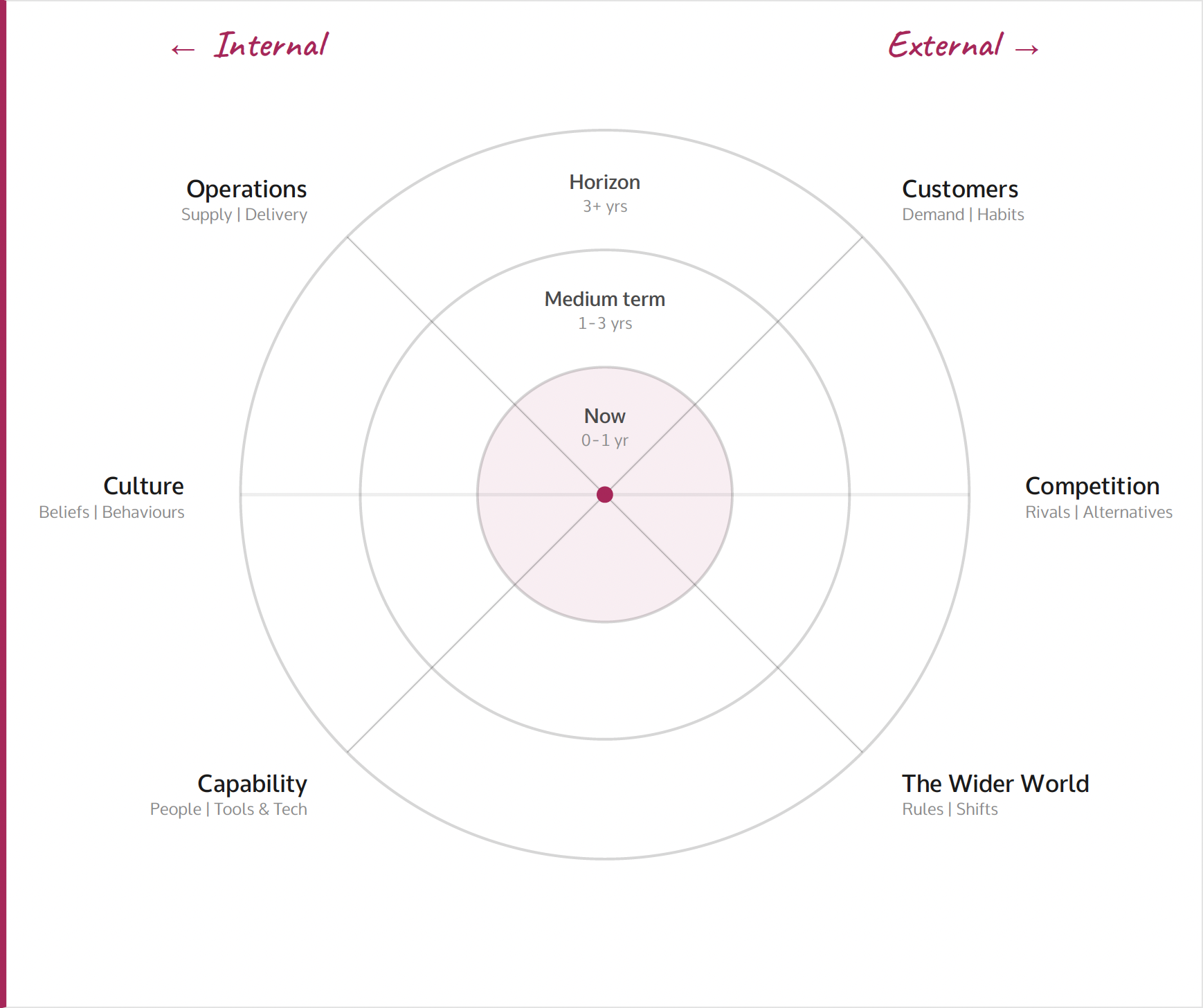
Playing to Win asks a team to choose where to play and how to win. The Radar is what I run first, because a team that has not looked outward together will choose from habit and gut feel. The exercise puts every force the team can name on one page, sorted by how soon it bites and where it comes from, with the size of each marker showing how much weight it carries.
Two things come out of it that feed the Cascade directly. The outer ring supplies the uncertainties that scenario planning is built from. And the gaps on the canvas, bearings where nobody has placed a marker, are where uncontested space usually sits, which is the first clue to a where-to-play choice worth making.

Inside the organisation: capability (people, tools, technology), culture (beliefs and behaviours) and operations (supply and delivery).
Outside it: customers (demand and habits), competition (rivals and alternatives) and the wider world (rules and shifts).
Take the outer ring of the Radar and build the futures your strategy has to survive.
The full cascade behind the 2013 radar sketched on this page.
The Strategy Choice Cascade from start to finish, and how I run it with boards.
I facilitate Playing to Win processes for executive boards and leadership teams. I bring the method, the questions and the pace. Your team makes the choices and owns them afterwards.