
Strategy Facilitation
Executive facilitation using the Playing to Win approach
I work with executive boards and senior leadership teams at the point where a decision has to be made and the team can't get there on its own. I run the process, you make the choices and own them, and you learn the method well enough to use it again without me.
I run the process. Your team makes the choices.
Good strategy is a set of choices. Where you will play, how you will win there, and what you will therefore stop doing. Get those settled and you ensure the rest of the business knows what to do on Monday.
Making those choices needs a room where the trade-offs can be said out loud. Every real choice closes a door for someone, so the conversation needs a structure that keeps it moving and someone holding it who has no stake in the answer.
That's my role. I bring the method, the questions and the pace, and I create the conditions for open, objective discussion.
You leave with your choices written down, made by the people who have to live with them. Six months on, when something lands that nobody predicted, your team can act on it without coming back to ask what the strategy meant.
You learn the method too, so the next round is one you can run yourselves.
The method: Playing to Win
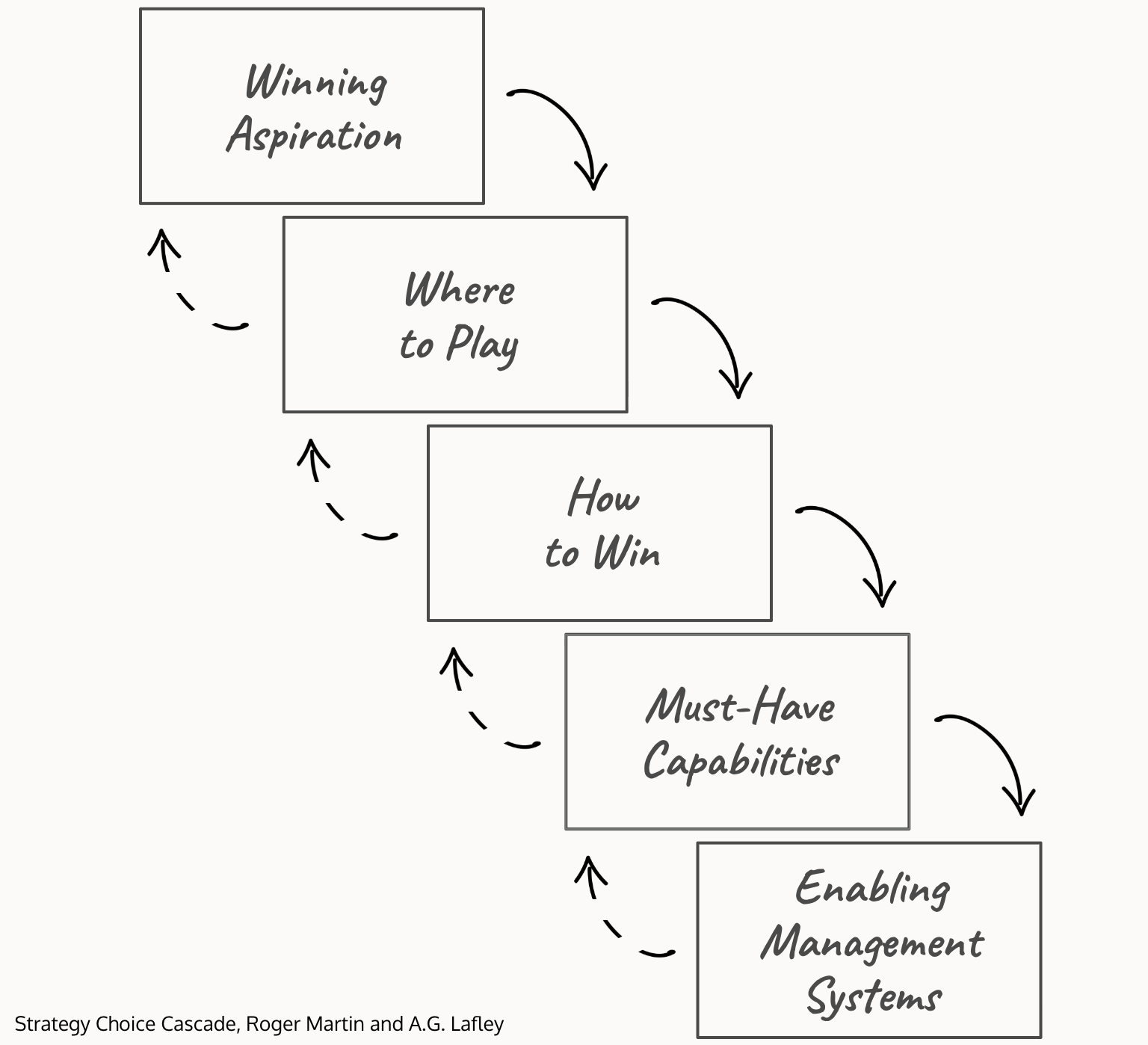
I work with Roger Martin and A.G. Lafley's Playing to Win method, and its Strategy Choice Cascade is a clear structure that helps a company choose where to play and how to win. It asks a team to answer five linked questions:
I also use the Strategic Choice Structuring Process, the method behind Playing to Win, which turns a debate into a sequence of testable choices.
Trusted by leaders at 250+ organisations
I've worked with leaders from a wide range of organisations, from corporate household names to agencies, public sector bodies, universities, charities and startups.


Other methods I work with
These are the models I bring in when a team needs to look further out, or to turn a choice into something the business can act on.
Horizon Scanning
Reading what is changing around your market
I run horizon scanning with my Strategy Radar tool, which maps the forces moving around your business and sorts them by weight of impact and how soon they matter.
Scenario Planning
Testing your strategy against futures you don't control
We build a small set of plausible futures and run your plans through each one. It shows which choices hold up whatever happens, and which only depend on one version of the future.
Jobs to Be Done
Understanding what customers hire you for
A team that agrees on the job a customer is hiring them to do can make much sharper decisions about where to play. I use Jobs to Be Done to get that written down in the customer's own terms.
Value Proposition Canvas
Matching what you offer to what customers want
We map customer jobs, gains and pains against what you sell, then look at where the fit is strongest. It usually settles the argument about which segment deserves the investment.
Business Model Canvas
Seeing the whole business on one page
Nine building blocks covering customers, channels, revenue and costs. Useful when a team is changing one part of the model and needs to see what moves with it.
OKRs
Turning strategic choices into quarterly focus
I help teams write objectives and key results that follow directly from their strategy, so the quarterly plan and the long-term choice point the same way.



Testimonials
I loved working with these clients, and am grateful for their kind words. Will you be next?
GET IN TOUCHFAQs
Some common questions asked in client conversations