
Real companies, each written up as a full Playing to Win cascade: winning aspiration, where to play, how to win, the capabilities that had to be built and the systems that drive it.
For each one I have also set out what would have to be true for the strategy to work, and what happened once the market proved those conditions right. That closing section is the outcome, written with hindsight. Roger Martin's happy story is the short version, usually one sentence, that a team writes at the start, before it knows.
The cascades are my reconstructions from public sources. They show the shape of a good answer. Use them to calibrate your own before you draft it in the Cascade Builder.
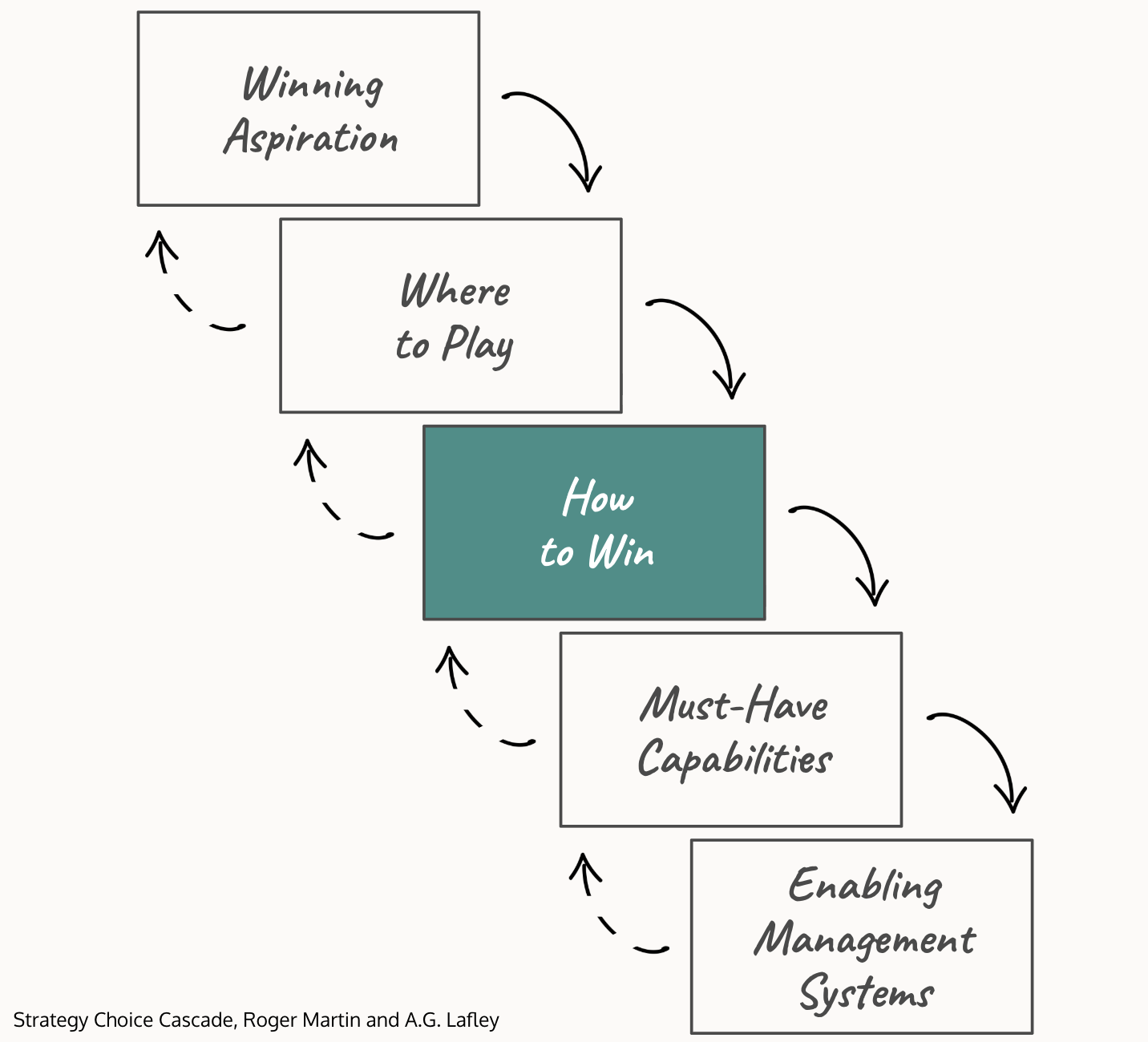
Each tab holds one company's five-step cascade, the conditions that had to be true for the strategy to work, and the payoff when the market proved them right.
Lead the North American skincare market, reach $1 billion in sales and rank among the global market leaders. A revived Olay would make skincare a pillar of P&G's beauty business alongside hair care.
Olay targets women from their mid-thirties who are starting to see the first signs of ageing, through drugstores, discount stores and grocers, in a new masstige segment. It turned down department stores and moved away from a customer base that was growing older every year.
Olay offers results to rival prestige creams for well under the prestige price, in shops women already use. Total Effects fights the seven signs of ageing and sells at $18.99, just below Clinique and well below Estée Lauder.
P&G's scientists find and prove new ingredients such as VitaNiacin, and its consumer research shows what women want beyond fewer wrinkles. Its sales teams persuade mass retailers to display Olay as a prestige brand.
Olay runs partnering systems with its retailers on display and pricing, and P&G worked hard to persuade them to hold the $18.99 price. It tracks channel and consumer measures to see whether the strategy is working in stores.
Women who buy prestige skincare will buy Olay at $18.99 in a drugstore, and mass shoppers will trade up to it. P&G tested prices of $12.99, $15.99 and $18.99 before choosing the highest.
Prestige brands such as Estée Lauder will stay out of mass retail, and mass rivals such as Neutrogena will be slow to copy the model.
P&G can make a product that visibly beats mass rivals and holds its own against prestige creams, at a cost that leaves a high margin at $18.99.
Sales grew by double digits every year for a decade, taking Olay from under $800 million a year to a $2.5 billion brand with high margins. Masstige became a category of its own, and P&G later sold Olay Pro-X at $50 in the same aisles.
Be the productivity and platform company that people and organisations pick first in a mobile-first, cloud-first world. In 2015 Satya Nadella set the mission as empowering every person and every organisation on the planet to achieve more.
Microsoft serves organisations moving their computing to the cloud through Azure and Office 365, and people using Office on whatever device they own, including iPad, iPhone and Android. It stopped holding Office back to protect Windows, and in July 2015 wrote down its Nokia phone business by $7.6 billion.
Large organisations can move to the cloud at their own pace with a supplier they already trust across their own servers, Azure and Office 365. Office stays the standard at work because it now works well on every device.
Microsoft has to run data centres worldwide at a cost close to AWS's and retrain its enterprise sales force to sell cloud. Its Windows-first engineers have to ship Office for iOS and Android and support Linux on Azure.
In April 2015 Microsoft set a public target of a $20 billion annual run rate in commercial cloud revenue by its 2018 financial year. It reported the run rate with its quarterly results and passed the target in October 2017. Nadella also rebuilt the culture around Carol Dweck's growth mindset.
Large organisations will move their Windows Server, SQL Server and Office work to the cloud, and will prefer a supplier that also supports the servers they keep in-house.
AWS can't easily match Microsoft's hold on corporate IT or its hybrid offer, and Google can't displace Office at work.
Microsoft can run cloud infrastructure at a cost close to AWS's, and its Windows-first teams can ship first-rate software for rival platforms.
Azure became the world's second-largest cloud, with 21% of the market to AWS's 28% in the first quarter of 2026, and Office runs on every major device. Microsoft's market value rose from just over $300 billion when Nadella took over in February 2014 to about $3.7 trillion in September 2026, helped since 2023 by its partnership with OpenAI.
Be the customer's favourite for food on the go, winning on value against the fast-food chains, the coffee shops and the supermarket meal deal.
Greggs sells breakfast and lunch on the go across the UK, from high streets and a growing number of roadside, forecourt, retail park and travel sites, many run by franchise partners. In 2013 it stopped competing with supermarkets on bread and dropped its Greggs Moment coffee shop format.
Greggs sells freshly baked savouries, sandwiches and coffee at prices the big chains struggle to match. It can do this because it makes and delivers its own food.
Greggs makes its food in its own specialist bakeries and delivers it with its own fleet, which keeps unit costs low. Franchise partners such as EG Group let it open quickly on forecourts, and a steady run of new products keeps customers coming back.
In 2016 Greggs began a £100 million, five-year plan to run its bakeries as one national network, with each main site making a few products for the whole country. Staff share 10% of the profits.
The food-on-the-go market will keep growing while bread moves to the supermarkets, and customers will choose on price and speed.
McDonald's, the coffee chains and the supermarket meal deal can't or won't match Greggs on price at breakfast and lunch.
Central manufacturing and Greggs' own delivery fleet can supply thousands of shops, including partner-run forecourts, at a cost low enough to keep prices below its rivals'.
Greggs became the UK's No.1 brand for breakfast food to go. The vegan sausage roll, launched in January 2019, helped lift underlying first-half profit that year by 58%, and sales passed £2 billion in 2024, though underlying profit fell 9% in 2025.
Win back the trust Tesco lost in the 2014 accounting scandal and stay the grocer UK shoppers choose first as Aldi and Lidl grow.
Tesco sells food in the UK and Ireland through large stores, Express shops and online, and from 2018 through Booker's wholesale business. It sold its businesses in South Korea, Turkey, Thailand, Malaysia and Poland and side ventures such as Blinkbox, Giraffe and Dobbies, but kept Central Europe.
Tesco gives mainstream shoppers discount prices on the basics, with the range, convenience and Clubcard member prices of a full-service grocer. Aldi Price Match, launched in March 2020, closed the price gap on hundreds of lines.
Tesco buys at the scale of more than a quarter of the UK grocery market, and it owns dunnhumby, the data science business that analyses what Clubcard members buy. A standing cost-saving programme pays for the price cuts.
Dave Lewis set a £1.5 billion cost-saving target for 2016 to 2020, and from March 2020 Tesco checked Aldi's prices twice a week. His "Big 6" KPIs put customer recommendation beside sales, profit and cash.
Enough shoppers will stay with a full-range grocer that matches Aldi on the basics, and will value Clubcard prices and convenience enough to buy the rest of their basket there.
Aldi and Lidl will keep growing, but mostly at the expense of Asda and Morrisons, and won't cut prices far enough to reopen the gap on matched lines.
Tesco can take out enough cost to fund lower prices and still rebuild its margin after a £6.4 billion loss in 2014/15.
Tesco stayed the UK's largest grocer and lifted its share from about 26.6% in 2020 to 28.5% in 2025/26, while Asda and Morrisons lost ground. Aldi and Lidl kept growing, to nearly 20% between them by 2026, so the price match protected Tesco's shoppers without stopping the discounters.
Be the UK's most trusted retailer, the one shoppers pick first for food and clothing because the quality is high and the price is fair. M&S set itself a five-year goal of one extra point of market share in both food and clothing and home.
M&S sells food for the family weekly shop as well as the treat, through bigger food stores and online through Ocado Retail, which it has half-owned since 2019. It sells clothing through M&S.com and a full-line estate it's cutting from 247 stores to about 180 larger ones, with partner brands such as Nobody's Child filling gaps in the range.
M&S sells quality that shoppers trust at prices they judge fair. It launched the Remarksable Value range in 2019, priced against competitors, to change the view that M&S is expensive, and by 2023/24 shoppers rated its value more highly.
M&S develops its own food with long-standing suppliers, and made more than 500 quality upgrades in the first half of 2023/24. Its property team moves stores to better sites, and its recent relocations earned back their net cost within two years.
A store rotation programme closes weaker stores and opens bigger, more productive ones, and in January 2023 M&S cut its timetable from five years to three. Nine strategic priorities come with public five-year goals, which by November 2023 included adjusted operating margins above 4% in food and 10% in clothing and home.
Shoppers who think M&S is expensive will change their minds once it cuts prices on staples, and will do more of their weekly shop there. Lapsed clothing customers will come back if the own label looks modern.
Tesco, Sainsbury's and Waitrose won't match M&S food quality at its prices quickly enough to stop it winning share.
M&S can take enough cost out of its stores and supply chain to fund lower prices, and can replace decades-old IT and logistics systems without disrupting trade.
Food sales rose 13% in 2023/24, and in the four weeks to 3 November 2024 M&S's grocery share passed Waitrose's outside Christmas for the first time. Profit before tax and adjusting items rose 58% to £716 million in 2023/24, then fell 24% in 2025/26 after a cyber attack in April 2025 halted online orders until June.
Make Burberry the luxury brand of choice for the next generation of wealthy customers worldwide: one brand, designed in London and built on its British heritage.
Burberry sells core outerwear, leather goods and accessories, mainly through its own stores and website, with a push into China and the Middle East. It cut back products covered in the check and ended licences where it could, buying back fragrance from Inter Parfums for €181 million in 2012.
Burberry stands apart as the authentic British heritage brand, centred on the trench coat, and it looks the same in every store and on every screen. It uses digital, including a live 3D stream of its February 2010 show, to reach younger customers before most rival houses do.
One design team in London, under Christopher Bailey, sets the look of every product, store and campaign. Burberry builds the skills to run its own retail business, which made 70% of revenue by 2013/14, and its own digital channels, starting with the Art of the Trench site in 2009.
Burberry ran the business against five strategic themes, set out in its annual reports, including retail-led growth and investment in under-penetrated markets. By 2011 it spent more than 60% of its marketing budget on digital, and nothing reached customers without Bailey's approval.
Younger wealthy customers, in China as much as in the West, will value British heritage and will find and buy the brand online.
Most luxury houses will hold back from social media and e-commerce long enough for Burberry to build a lead.
Burberry can pay for its own stores and for buying back licences and franchises out of its own cash flow, and keep paying even when luxury demand falls.
Revenue tripled from £743 million in 2005/06 to £2.33 billion in 2013/14, and in 2015 the research firm L2 ranked Burberry first in its Fashion Digital IQ report. After a slump in 2024, the chief executive Joshua Schulman's Burberry Forward plan went back to outerwear and British heritage.
Rolls-Royce's stated aim is a "high-performing, competitive, resilient and growing" company with "the financial strength to control and shape its own destiny". Every word describes the company's finances and no customer or rival appears, which makes it a weak aspiration in Martin's terms.
Rolls-Royce makes and services engines for widebody and business jets, and works in defence, power systems and small nuclear reactors, with a return to narrowbody only through a partner. It dropped all-electric flight, deciding in 2024 to close Rolls-Royce Electrical after no buyer came forward.
Rolls-Royce sells the engine with a long-term service agreement that carries the risk of keeping it flying, and it's the only engine offered on the A350 and A330neo. From 2023 it priced new and renewed agreements to that value and renegotiated loss-making contracts.
Rolls-Royce engineers have to lengthen time on wing for the Trent fleet, and its service network has to cut the cost of each shop visit. Its defence arm designs, builds and supports the reactors that power the Royal Navy's submarines.
Under CEO Tufan Erginbilgic, four group targets were set in November 2023 to cover operating profit, margin, free cash flow and return on capital. In October 2023 Rolls-Royce merged its engineering, procurement and support functions into single group-wide teams to remove duplication and up to 2,500 roles.
Airlines and lessors will accept higher prices on new and renewed service agreements, because changing engine maker on a sole-source aircraft isn't an option.
GE will compete for new widebody orders rather than cut prices on installed fleets, and supply problems across the industry will keep aftermarket prices firm.
Rolls-Royce can lengthen time on wing and cut shop-visit costs fast enough to justify higher prices, while still funding UltraFan and small nuclear reactors.
When Tufan Erginbilgic arrived at Rolls-Royce in January 2023, the share price was 91p. By mid 2026, it was £14.
Be the construction toy that children, parents and the big toy retailers choose first, on a core brick business that makes money again.
Lego sells classic construction toys to children and their parents through the big toy retailers, with licensed themes such as Star Wars kept as a supporting line. In 2005 it sold the Legoland parks to a company controlled by Blackstone, keeping a 15% stake, and it handed video games to licensed partners.
Parents pay more for Lego because every brick fits every set and lasts for years, and the themes give children a reason to build. A much smaller range of parts brings the cost of that premium product back under control.
Designers build new sets from a smaller shared palette of parts, and the company delivers retailer orders on time. After outsourcing some moulding, Lego ended the deal in 2008 and took moulding back in-house as a core skill.
A cost matrix shows designers the price of every new colour or shape, with rules for approving them, and profit is tracked product by product so loss-making lines can go.
Enough parents will keep paying a premium for classic lines such as City and Technic to stop core sales falling, and retailers will restore shelf space once Lego delivers on time.
Cheaper brick makers can't copy Lego's quality and system closely enough to win parents on price, and video games won't pull children away from building.
Cutting the range of parts by about half will lower supply chain costs without making the sets less fun to build.
Lego returned to a net profit of DKK 505 million in 2005, after a DKK 1.9 billion loss in 2004, and its sales grew every year for the next decade. By 2015 it made more than twice Mattel's profit on lower sales, helped by The Lego Movie in 2014.
The tabs above give the shape. These pages give the working: how each choice was reached, which condition was the risky one, and what a board would ask if it were writing the cascade today.
I facilitate Playing to Win processes for executive boards and leadership teams. I bring the method, the questions and the pace. Your team makes the choices and owns them afterwards.