
Start with a one-line happy story, then draft your Strategy Choice Cascade in seven guided questions. Each one comes with sentence starters, a quality check and an example, so you write a real answer instead of a slogan.
You finish with a full cascade, the conditions that would have to be true for it to work, and a short account of what winning looks like. Email it to yourself and take it to your team.
If you are new to the method, read the Playing to Win page first.
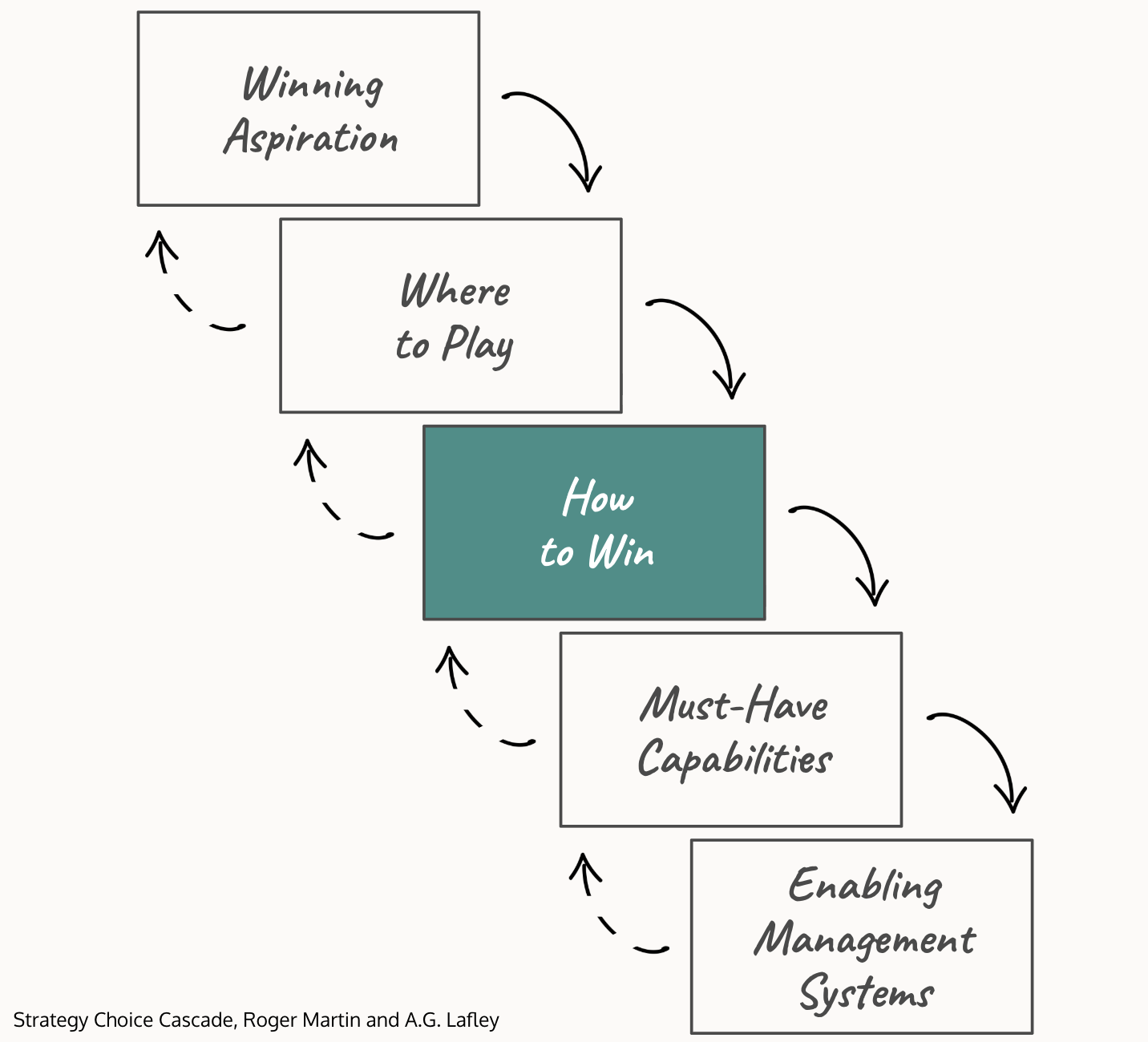
Complete your cascade, one stage at a time. Each comes with a sentence starter, a short test of what good looks like, and a live example. You'll finish with a first draft to take to your team.
Roger Martin starts here. Write one sentence naming a move you could make and the prize that follows. It does not have to be true yet. It has to be attractive enough that your team wants to find out.
"If we shift our focus for older women to women between 25 and 49 fighting the first signs of aging, we can build a giant brand."
One sentence that names what winning means for you and who you win with. Purpose first, numbers second. Use the suggested format or design your own.
Lead the North American skincare market, reach $1 billion in sales and rank among the global market leaders. A revived Olay would make skincare a pillar of P&G's beauty business alongside hair care.
Choose your battlefield across five fields: geographies, customer segments, channels, product categories, and your stage of the value chain. What you rule out matters just as much.
Tesco sells food in the UK and Ireland through large stores, Express shops and online, and from 2018 through Booker's wholesale business. It sold its businesses in South Korea, Turkey, Thailand, Malaysia and Poland and side ventures such as Blinkbox, Giraffe and Dobbies, but kept Central Europe.
There are two routes: lower cost or differentiation. Pick one deliberately, then write it from your customer's point of view.
Greggs sells freshly baked savouries, sandwiches and coffee at prices the big chains struggle to match. It can do this because it makes and delivers its own food.
The few things you must be excellent at for the first three stages to be possible. Aim for three to five that reinforce each other.
Designers build new sets from a smaller shared palette of parts, and the company delivers retailer orders on time. After outsourcing some moulding to Flextronics, Lego ended the deal in 2008 and took moulding back in-house as a core skill.
The measures, rhythms and incentives that make the choices stick.
In April 2015 Microsoft set a public target of a $20 billion annual run rate in commercial cloud revenue by its 2018 financial year, and passed it in October 2017. From July 2017 salespeople were paid on customers' use of Azure, and Nadella rebuilt the culture around Carol Dweck's growth mindset.
Now reverse the test. For your cascade to work, what must be true about your customers, your competitors, and your own capabilities and costs? Write conditions you could go and check.
Younger wealthy customers will value British heritage and buy online. Most luxury houses will hold back from digital long enough for Burberry to build a lead. Burberry can pay for its own stores and licence buy-backs out of its own cash flow, even in a downturn.
The world three years from now, as if the conditions came true. Past tense, one customer behaviour, one number. This is the outcome, written with the choices already made, so it is a different thing from the happy story you began with.
It's 2019. Commuters treat Greggs as the place for a cheap, hot breakfast, and new customers come in for the vegan sausage roll. Underlying first-half profit is up 58% on the year before.
Here's your Cascade in full. Take it to your team and get their feedback.
I'll send your draft so you have it to hand, and add you to On The Same Page, my weekly newsletter. Unsubscribe any time.
I facilitate Playing to Win processes for executive boards and leadership teams. I bring the method, the questions and the pace. Your team makes the choices and owns them afterwards.