
A strategy is a choice, and you cannot choose from a list of one. Yet most strategy processes arrive at the executive team with a single recommendation and a set of slides that support it. The team can say yes or send it back. It cannot choose.
Playing to Win puts a step before that. The team generates a small set of real possibilities, each one a coherent story of how the company could win, and each different enough from the others that choosing one means giving up the rest. The status quo is always on the list.
This page explains what a real possibility looks like, how I run the session where an executive team writes its own, and why the writing has to be theirs.
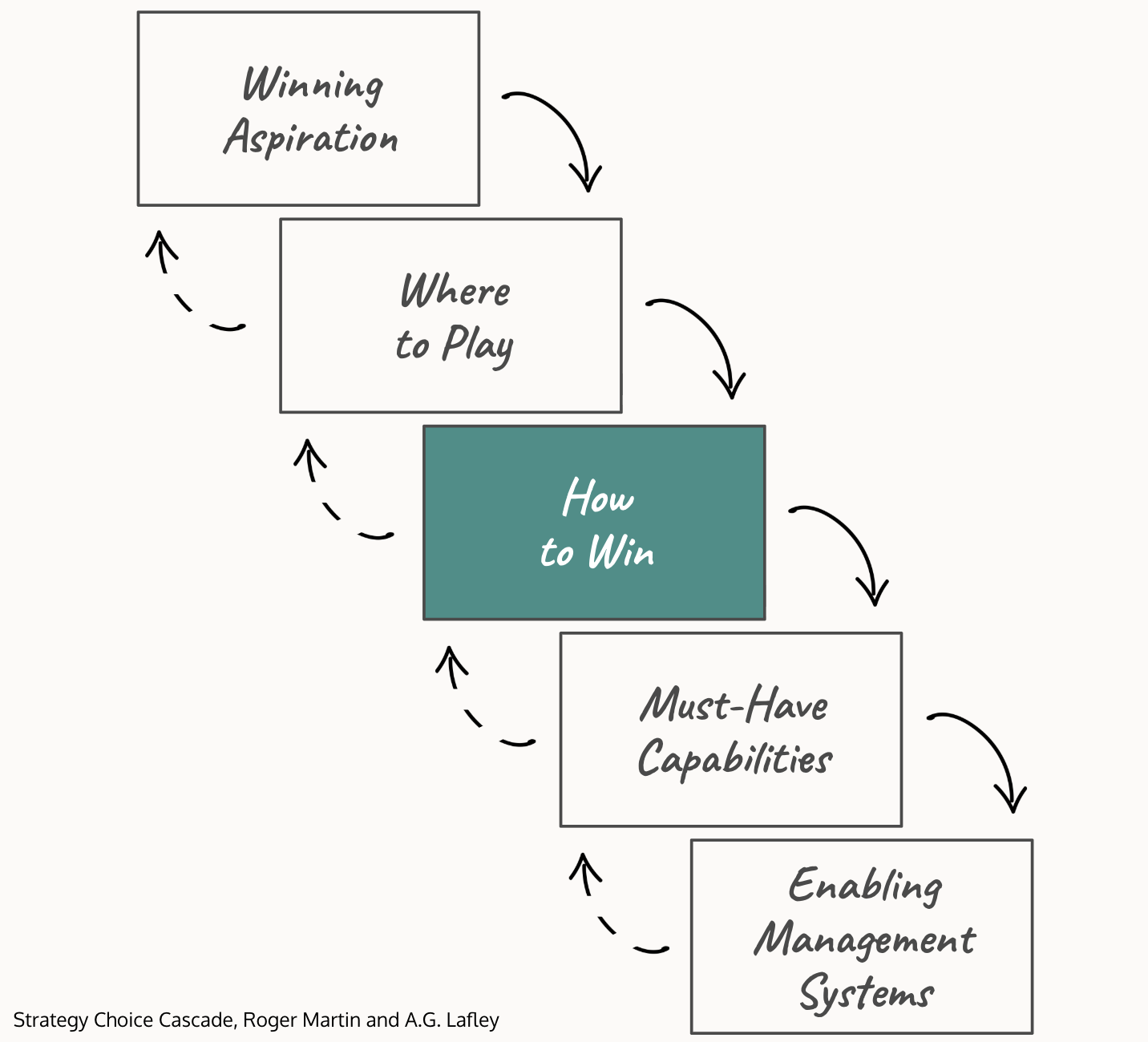
Roger Martin's name for a possibility is a happy story: a short account of how the company wins, written to be attractive enough that the team wants to go and work on it.
He sets two constraints. In the story, the gap between the results you are getting and the results you want disappears. And the choices needed to make it real can be listed, so the logic can be laid out.
A happy story is usually one sentence, and it is conditional. It names a move the company could make and the prize that follows, so it describes a future the team might build.
"The story doesn't have to be true/certain to succeed. But it has to be happy, and the logic has to be laid out."
- Roger Martin
Three to five are enough. Martin is explicit that he does not mind if happy stories overlap, and that chasing an exhaustive list wastes the energy of the room. What he asks for is variety: when every story is a minor variant along one vector, ask for one that feels importantly different.
The status quo goes on the list too, written with the same care as the others. It's also a choice, and writing it out is often when a team realises it has been choosing it by default for years.

"If we shift our focus for older women to women between 25 and 49 fighting the first signs of aging, we can build a giant brand."
"If we keep control of the package from shipper to recipient, people will have confidence it will get there when promised."
Teams rarely lack ideas. They sometimes lack permission to write down the ones that would change something. These four prompts give it.
Greggs' possibility was change how: be the cheapest place for a freshly baked breakfast or lunch on the go, and leave bread to the supermarkets. Tesco's was keep going, sharpened: exit the sprawl and win the core UK grocer's game against the discounters.
These worked examples show where each of eight companies landed.
The executive team writes the possibilities itself, in the room, at the middle of the three sessions. That holds whatever the size of the company. What changes is who gathers the evidence first, because possibilities written without evidence are guesses.
With a working group. Four people spend the weeks before the middle session collecting what customers are doing, how competitors have moved, the economics of each segment, and the capabilities the company has and lacks. They bring it to the session as raw material for the team to work from. This suits a company with the people to spare and a review big enough to need them.
Without one. In a smaller company the executives do the gathering themselves. I split the evidence four ways at the end of the first session and each executive brings one part back: customers, competitors, economics, capabilities. It's about an hour of work each, and the people who write the possibilities have then read the evidence with their own eyes.
Either way, the team works in pairs at the middle session, each pair taking one way in from the list above, and writes a possibility as a happy story. The pairs read their stories aloud. The room combines, sharpens and cuts until four or five stand, one of them the status quo.
The reason for doing it this way is ownership. A team that reviews a consultant's shortlist can reject it. A team that wrote the possibilities has already committed to taking one of them seriously, and the choice it makes at the final session is its own.

Ask each executive to write, alone and in five minutes, one sentence that starts "If we..." and ends in a positive outcome.
Read them aloud in turn and write each one on the wall in the words the writer used.
Then sort. Put the sentences telling the same story together. Expect four groups (as outlined above), and expect one of them to be the status quo in better clothing.
Take the strongest sentence in each group and sharpen it as a team until both halves are clear: the move you'd make, and the prize that follows. Those are your possibilities.
If everyone's story matches, you have one strategy and can go straight to testing what would have to be true. If they diverge, the team was carrying its possibilities around unspoken and they're now on the wall where you can choose between them.
The step after this one: turn each possibility into conditions, find the one that matters most, and test it.
See where Greggs, Tesco, M&S and five others landed once they had chosen one possibility over the rest.
Take your strategy or idea and turn it into a full cascade with seven guided questions.
I facilitate Playing to Win processes for executive boards and leadership teams. I bring the method, the questions and the pace. Your team makes the choices and owns them afterwards.